
What to Know Before Hiring a Local Contractor
A local contractor should bring more than construction skills: they should provide clear project leadership, local permitting knowledge, dependable communication, and a documented approach to residential construction services for custom homes and major renovations. The right fit understands your property, listens to your goals, coordinates every phase of work, and explains what happens when plans uncover an unexpected condition.
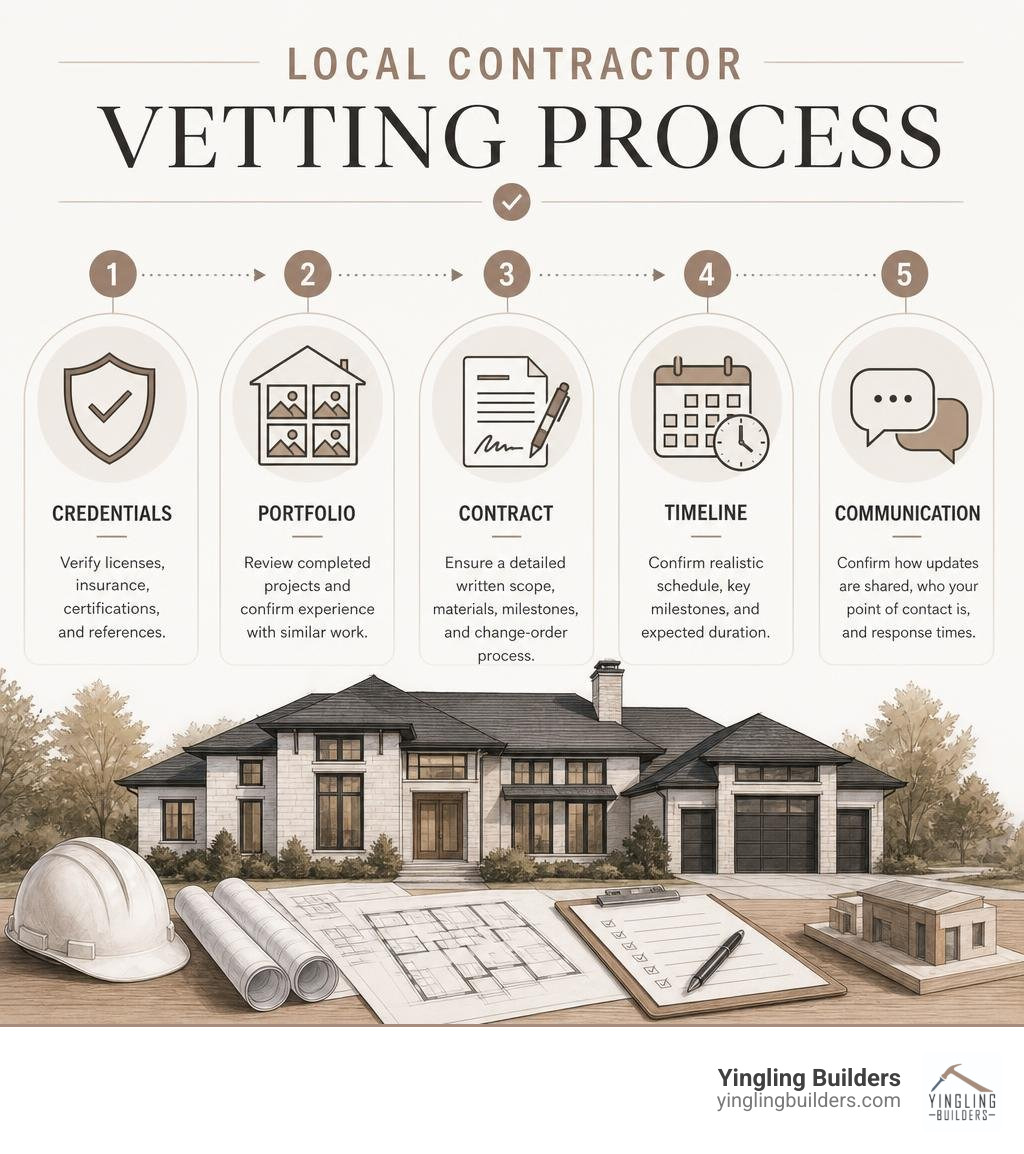
- Verify licensing, insurance, credentials, and recent references directly.
- Review completed work and confirm experience with projects similar to yours.
- Expect a detailed written scope, material selections, milestones, and change-order process.
- Confirm who performs the construction work and who manages design coordination.
- For Yingling Builders, a typical custom-home construction timeline is approximately 10–12 months, depending on project scope, site conditions, permitting, and selections.
Hiring a local contractor can feel high-stakes, especially when your home must reflect a major life change, a long-held vision, or recovery after a loss. Yingling Builders approaches custom construction with an in-house team completing construction work, while a team of expert designers or trusted partners can support the planning process. Optional authentic renderings can also help homeowners visualize important decisions before construction begins.
This guide covers the important details that are often left vague until a project is underway, from credentials and contracts to realistic timelines, local regulations, and quality oversight.
1. Early Planning Documents Can Be Incomplete and Commitments Should Be Clearly Structured
When starting a luxury residential project, early planning documents provided by an Illinois home builder can sometimes present an oversimplified picture of the true project scope. Homeowners often approach contractor selection cautiously because incomplete early information can make the construction process difficult to evaluate. An experienced local contractor understands that early architectural plans must align directly with physical feasibility on your site. Without a meticulous breakdown covering structural framing, excavation requirements, utility hookups, and finish-grade materials, early proposals often leave out crucial project components that surface later as scope adjustments.
To safeguard your project planning, early commitments should always be tied to clearly defined milestones and written documentation. Industry best practices favor a structured pre-construction process where approvals, selections, and long-lead custom items – such as hand-crafted cabinetry or specialized architectural glass – are documented before construction activity begins. At Yingling Builders, we emphasize complete clarity from day one. Early site evaluations across West Central Illinois help our team identify structural, site-access, utility, and planning considerations before construction begins. Homeowners looking to evaluate custom options can explore our Custom Home Builders Near Me Planning Guide resource to understand how structural scope and craftsmanship details form the foundation of a successful build.
Asking the Right Questions Before Hiring a Local Contractor
Before committing to a contract with a local contractor, asking targeted operational questions reveals how organized and reliable their build process will be:
- What is your current active workload, and how many active sites does your management team oversee simultaneously?
- How do you handle subcontractor logistics, and are specialty trades aligned within your master schedule?
- What formal communication schedule do you maintain, and do you utilize digital platforms like BuilderTrend to share daily job site updates, photos, and schedule tracking?
- What structured milestone review process do you utilize, and how are pre-construction approvals documented prior to site mobilization?
- What contingency protocols exist when unforeseen ground conditions or weather disruptions occur during early site preparation?
When evaluating an Illinois home builder or local contractor, look for organized schedules, clear milestone updates, and a defined system for coordinating each phase of construction. Utilizing BuilderTrend software allows us to provide real-time visibility into project progression, giving clients peace of mind from initial excavation through final interior finishing.
2. Licenses, Insurance, and BBB Ratings Require Direct Verification

Verifying credentials is an essential step when selecting a local contractor for your custom home build or extensive home addition. Verify the contractor’s applicable insurance coverage, any locally required registrations, and credentials for state-regulated trades rather than relying on general claims of compliance. General liability insurance protects your property against unexpected site damage, while workers’ compensation safeguards homeowners from personal liability in the event of a worker injury on site.
Use the BBB to review business history and customer feedback, and use official Illinois licensing resources to verify credentials for trades regulated by the state. Standard directory ratings evaluate how an organization resolves client feedback and maintains standard business practices over time. When evaluating prospective builders across Morgan County IL or Cass County IL, homeowners can check regional community discussions to review client experiences. Before construction begins, ask your local contractor to document applicable insurance coverage, trade credentials, and required local registrations.
How to Verify Your Local Contractor Credentials and References
Thorough verification goes beyond scanning a written list of phone numbers provided in a sales folder. To properly vet a prospective local contractor, take these proactive verification steps:
- Request certificates of insurance directly from the contractor’s insurance carrier rather than accepting photocopied documents.
- For state-regulated trades, use the appropriate Illinois licensing database, and confirm any contractor-registration or permit requirements directly with the municipality where the project will be built.
- Conduct in-depth reference checks with recent clients, asking detailed questions about schedule adherence, job site cleanliness, communication transparency, and how minor site delays were managed.
- Visit active job sites or completed custom projects to evaluate physical craftsmanship, trim execution, structural framing precision, and site safety standards firsthand.
Examining completed work in communities like Mt Sterling IL, Quincy IL, or Jacksonville IL gives you direct insight into a builder’s standards. Seeing actual framing alignment, custom finish work, and organized job site operations provides clear proof of professional project leadership.
3. General Contractor vs. Specialty Contractor: Knowing the True Scope
Understanding the operational differences between a full-service general local contractor and single-trade specialty contractors is crucial for project success. A specialty contractor focuses exclusively on a single discipline—such as electrical wiring, diagnostic plumbing, flatwork concrete, or roofing installation. While specialty trades possess deep technical skill within their narrow domain, they do not manage multi-trade logistics, municipal building permits, architectural plan alignment, or overall construction schedules.
Conversely, a full-service local contractor can coordinate residential construction services across planning, permitting, site work, construction, inspections, and project closeout. We oversee every trade, acquire necessary municipal permits, direct site logistics, streamline materials delivery, and ensure building code compliance across all structural elements. Our clients work directly with expert project leaders rather than juggling multiple independent trade workers. Learn more about how our expert coordination simplifies custom projects through our Home Improvement Contractors resource.
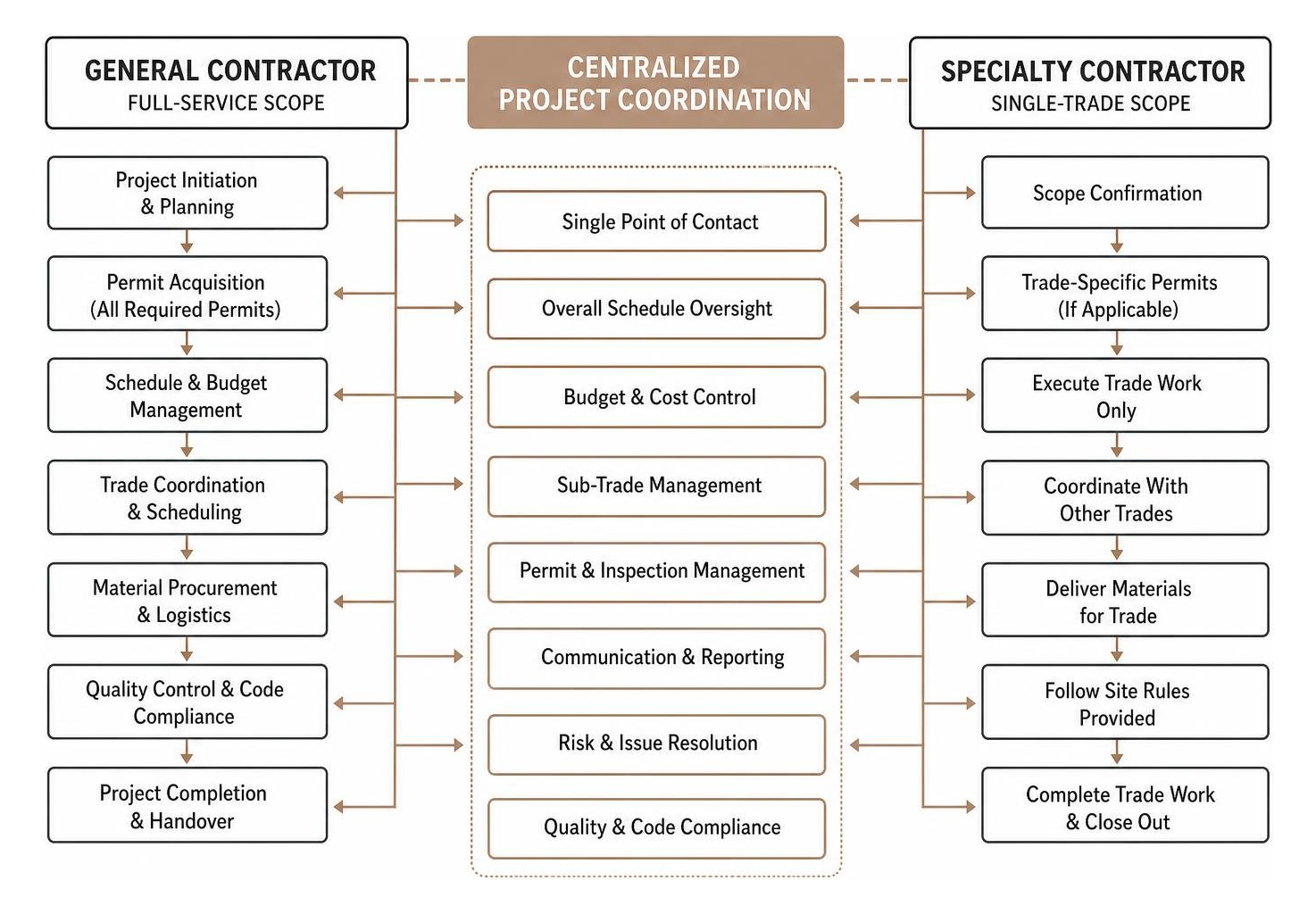
| Service Feature | Full-Service General Contractor | Single-Trade Specialty Contractor |
|---|---|---|
| Project Management | Manages complete end-to-end schedule and sub-trades | Focuses solely on individual trade task |
| Permit Acquisition | Pulls all municipal building and zoning permits | Handles trade-specific permits only (if applicable) |
| Architectural Integration | Ensures whole-home plan alignment and engineering | Executes work based strictly on pre-existing conditions |
| Trade Coordination | Coordinates multi-subcontractor workflow seamlessly | Operates independently without trade scheduling oversight |
| Warranty Coverage | Provides comprehensive structural and project warranty | Offers warranty limited strictly to single trade scope |
Full-Service Capabilities Offered by General Contracting Teams
Comprehensive residential construction requires seamless execution across numerous specialized disciplines. A full-service local contractor manages a complete spectrum of construction capabilities:
- Complete custom home construction designed around individualized lifestyle needs and site layouts.
- Whole-home remodeling and structural additions, expanding living spaces with seamless architectural alignment.
- High-end structural framing using premium grade timber and advanced engineering specs.
- Professional site excavation, site grading, laser-level pad preparation, and engineered foundation work.
- Diagnostic plumbing integration, high-efficiency mechanical layout, and modern electrical grid planning.
- Weather-resistant exterior envelope installations, including energy-efficient siding, architectural roofing, and high-performance window systems.
- Custom outdoor living features, structural composite decking, and dedicated estate developments such as Neylon Farms.
Managing these distinct elements demands unified leadership to ensure structural integrity and long-lasting quality across every corner of your home.
4. Why Local Contractor Knowledge Matters for Permitting, Site Conditions, and Materials
Choosing a regional local contractor over a distant national chain provides distinct advantages in municipal permit acquisition, regional code compliance, and climate-tailored material selection. West Central Illinois experiences severe seasonal weather variations, ranging from intense freeze-thaw cycles in winter to humid summer conditions. Regional building knowledge can help a contractor account for local permitting practices, soil conditions, frost considerations, and climate-related material performance.
An experienced Illinois home builder deeply understands regional zoning codes and municipal permitting procedures in communities across Pike County IL, Brown County IL, and Schuyler County IL. For exterior concrete exposed to freezing conditions, the specified mixture should account for freeze-thaw durability, including appropriate air entrainment and project-specific performance requirements. Air-entrained concrete contains microscopic air bubbles that absorb moisture expansion during winter freezing cycles, preventing surface scaling and structural cracking.
Similarly, local experts prioritize long-term exterior material performance. A local contractor can help compare wood and composite decking based on durability, maintenance requirements, manufacturer guidance, and performance in local weather conditions. To explore localized builder credentials in your specific community, explore our dedicated Local Home Builders portal.
5. Detailed Contracts and Change Order Protocols Create Clear Project Accountability
A comprehensive, written contract forms the backbone of a stress-free custom building experience. A trustworthy local contractor will never rely on informal handshake agreements or vague one-page summaries. Every contract should feature explicit scope definitions, complete architectural drawings, clear material specifications, and defined milestone schedules.
Detailed contracts must outline how unexpected site conditions—such as buried rock, high water tables, or legacy framing defects uncovered during structural alterations—are evaluated and addressed. A formal change order protocol ensures that any adjustment to project scope or material selection is documented in writing before work proceeds. This written process details the precise structural changes, timeline impacts, and material adjustments involved, preventing unexpected scope creep and preserving complete transparency throughout construction.
Homeowners evaluating a local contractor in Brown County can use documented scopes, milestone communication, and written change procedures to better understand how a project will be managed.
6. Real Construction Timelines Take 10–12 Months and Require In-House Execution
One of the most vital facts an honest local contractor can share is a realistic construction timeline. A well-managed custom home or extensive renovation requires enough time for permitting, inspections, sequencing, craftsmanship, and quality-control checkpoints. At Yingling Builders, a local contractor serving West Central Illinois, a typical custom-home construction schedule is approximately 10–12 months, with timing varying by project conditions.
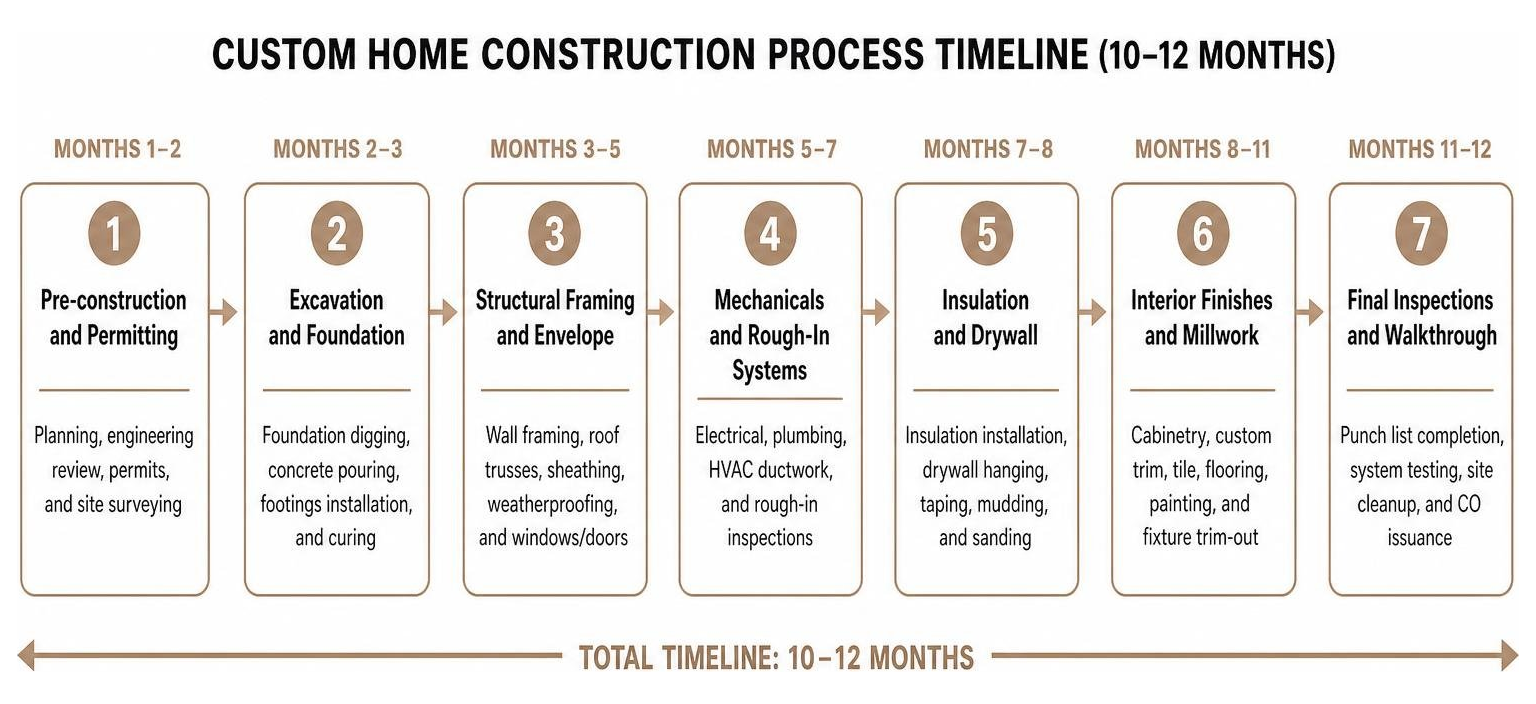
This realistic 10–12 month construction timeline accounts for critical project phases:
- Pre-construction and Permitting (Months 1–2): Architectural planning, engineering review, municipal permit acquisition, and site surveying.
- Excavation and Foundation (Months 2–3): Foundation digging, concrete pouring, footings installation, and proper curing time.
- Structural Framing and Envelope (Months 3–5): Precision wall framing, roof truss placement, exterior sheathing, weatherproofing, and window/door installation.
- Mechanicals and Rough-In Systems (Months 5–7): Electrical wiring, diagnostic plumbing installation, HVAC ductwork, and municipal rough-in inspections.
- Insulation and Drywall (Months 7–8): High-R insulation installation, drywall hanging, taping, mudding, and surface sanding.
- Interior Finishes and Custom Millwork (Months 8–11): Cabinetry installation, custom trim, tile setting, hardwood flooring, painting, and fixture trim-out.
- Final Inspections and Walkthrough (Months 11–12): Comprehensive punch list completion, system testing, site cleanup, and final certificate of occupancy issuance.
Yingling Builders coordinates construction through its in-house team, with expert designers or trusted partners supporting planning and specialized needs where appropriate. Design services are handled by a team of expert designers or trusted partners, providing seamless collaboration between initial planning and hands-on build execution. Optional authentic renderings are also available to help clients visualize structural options and interior layout details before framing begins. You can review our full step-by-step build management methodology on our custom construction process page and explore our full range of structural services through our Home Remodeling Company section.
7. Post-Construction Warranties and Punch Lists Support Long-Term Quality
The relationship with your Illinois home builder should not end on the day key turnover occurs. A dedicated local contractor should provide structured post-construction support, clear warranty documentation, and a defined process for addressing items identified after completion. As structural elements settle naturally into their foundation over initial seasonal cycles, minor cosmetic adjustments or mechanical fine-tuning may be necessary.
A formal post-construction protocol includes a structured punch list walkthrough before project closeout. During this detailed walkthrough, homebuilders and clients inspect every room, test mechanical systems, examine custom trim joints, check window operation, and verify finish quality. Any item requiring minor adjustment is formally documented and addressed by our in-house construction team.
Your local contractor should clearly document warranty coverage, exclusions, responsibilities, and the process for requesting post-construction service. Comprehensive builder warranties cover structural framing components and core craftsmanship standards, ensuring your home remains solid, durable, and comfortable for decades to come.
Frequently Asked Questions About General Contracting
How do I handle unexpected issues or scope changes during a construction project?
Unexpected ground conditions, weather shifts, or interior structural surprises during major renovations require a clear, documented process. When an unexpected condition arises, an experienced local contractor stops work in the affected area, conducts a physical assessment, and provides a formal written change order detailing the required structural modification and schedule adjustments. Work resumes only after you review and approve the documented plan.
What factors cause custom construction scope to fluctuate across different projects?
Custom construction planning fluctuates based on architectural complexity, overall square footage, site excavation requirements, foundation engineering specs, structural material grades, custom interior finishes, and specialized trade labor availability. Evaluating these structural factors early in the planning phase ensures complete scope alignment with your design goals.
What is the typical timeline for building a high-end custom home with a builder?
For a typical Yingling Builders custom home, a local contractor may plan around a roughly 10–12 month construction schedule, depending on project-specific conditions. This structural timeframe allows for proper municipal permitting, precise site grading, complete foundation curing, expert structural framing, high-efficiency mechanical installation, custom interior finishing, and thorough quality inspection walkthroughs.
Conclusion
Choosing the right local contractor is one of the most important decisions in planning a custom home or major renovation. By prioritizing process transparency, verifying applicable insurance and credentials, establishing written change-order procedures, and confirming a realistic project schedule, homeowners can make a more informed contractor decision.
Yingling Builders delivers a stress-free, highly organized building experience throughout West Central Illinois—including Mount Sterling IL, Quincy IL, Pittsfield IL, Griggsville IL, Jacksonville IL, Beardstown IL, Winchester IL, White Hall IL, Rushville IL, and surrounding counties. Construction is completed by our expert in-house team, supported by a team of expert designers or trusted partners, with optional authentic renderings available to bring your vision to life.
If you are evaluating residential construction services in West Central Illinois, choose a local contractor who prioritizes clear communication, documented processes, and dependable craftsmanship. Contact Yingling Builders today to discuss your custom home, renovation, or residential construction project.