
Why Calculating Rebuild Cost Is the Most Important Number Your Home Has

Calculating rebuild cost is the process of estimating how much it would cost to completely reconstruct your home from the ground up — using today’s labor rates and material prices.
Here’s a quick answer to get you started:
How to calculate your home’s rebuild cost:
- Measure your home’s total square footage (exterior dimensions)
- Find the local cost per square foot to build in your area
- Multiply square footage × local build cost per sq ft
- Add costs for custom features, materials, and finishes
- Include extras like debris removal, permits, and professional fees
- Compare your result against your current insurance dwelling limit
This number is not your home’s sale price. It’s not what you paid for it. It’s what it would actually cost to rebuild it — brick by brick — if disaster struck tomorrow.
That distinction matters more than most homeowners realize.
Many homeowners discover coverage gaps only after a major claim, which is why calculating rebuild cost should be reviewed before a loss occurs. In many cases, homeowners are short by 25% or more. That’s not a coverage gap — that’s a financial crisis at the worst possible moment.
Whether you’re reviewing your insurance policy, planning a custom build, or rebuilding after a loss, knowing your accurate rebuild cost is the foundation everything else rests on.
Understanding the Basics of Calculating Rebuild Cost
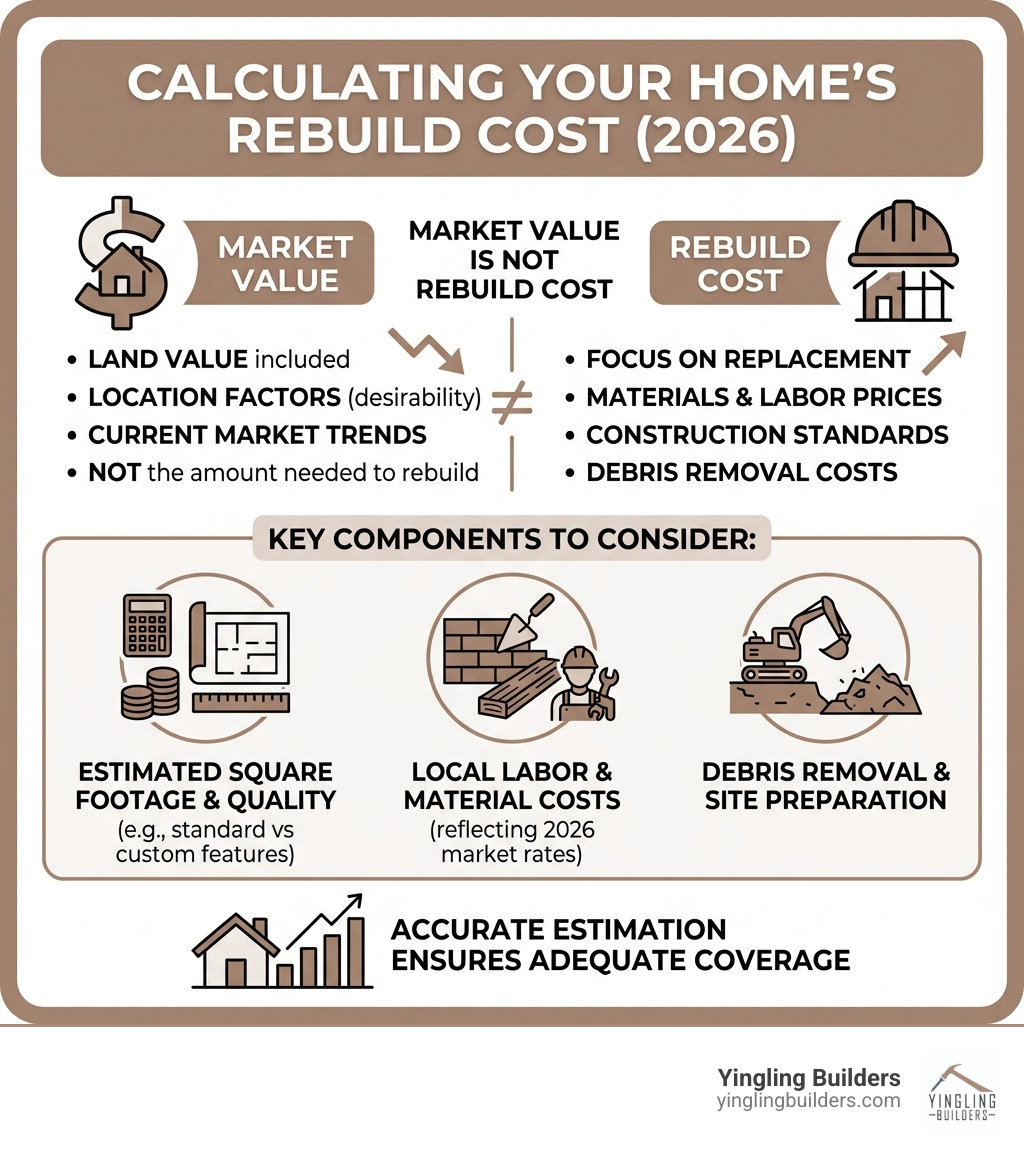
Calculating rebuild cost (also known as replacement cost) is the total financial investment required to reconstruct your home from the ground up using current labor rates and material prices. Unlike market value, it excludes land costs and focuses entirely on the physical structure.
At Yingling Builders, we see many homeowners confuse these two numbers. However, for insurance purposes and long-term security, the cost to physically build the structure is the only figure that ensures you can actually move back into a home of the same quality if the unthinkable happens.
Rebuild Cost vs. Market Value
The primary difference between rebuild cost and market value is that market value includes the land your home sits on and is influenced by external economic factors like school district demand and local property taxes.
- Market Value: The price a buyer is willing to pay for your home and land in the current real estate market.
- Rebuild Cost: The literal cost of materials (lumber, roofing, flooring) and the skilled labor required to assemble them into your home.
Because market value includes land and location prestige, it is often higher than the rebuild cost. However, in some cases—especially with older homes featuring intricate craftsmanship or during periods of high material inflation—the cost to rebuild can actually exceed the market value. For a deeper dive into these nuances, How to Calculate Your Home’s Replacement Cost – NerdWallet provides excellent context on how these figures diverge.
Why Accuracy Matters for Homeowners Insurance
Accuracy in calculating rebuild cost is essential because it determines your “dwelling coverage” (Coverage A) limit. If you underestimate this number, you face the risk of underinsurance.
If a total loss occurs—such as a devastating fire—and your coverage is based on an outdated or inaccurate estimate, the insurance payout may not cover the full cost of construction. This leaves you to pay the difference out of pocket. For those facing the daunting task of rebuilding, having a professional-grade estimate is the first step toward a stress-free recovery.
Key Factors Influencing Replacement Value
The cost to replace a home is driven by the specific characteristics of the structure, ranging from the foundation type to the complexity of the roofline. No two homes are identical, and even small changes in design can lead to significant shifts in the final tally.
Square Footage and Structural Complexity
The most obvious factor is the total area of the home. However, square footage alone doesn’t tell the whole story. A 2,000-square-foot ranch is often less expensive to rebuild than a 2,000-square-foot two-story home with a complex footprint.
- Story Count: Multi-story homes require different structural support and scaffolding.
- Foundation Type: A full walk-out basement costs significantly more to reconstruct than a simple crawl space or slab.
- Roofline: Gables, dormers, and steep pitches increase both material waste and labor time.
For more information on how structural choices shape your rebuild scope, see our guide on Decoding The Dollars: A Comprehensive Look At Home Building Costs Per Square Foot.
Material Quality and Custom Finishes
The “quality tier” of your home is a massive variable. Standard builder-grade materials are priced very differently than the high-end finishes we specialize in at Yingling Builders.
- Flooring: The cost gap between laminate and hand-scraped solid hardwood is substantial.
- Cabinetry: Custom-built, solid wood cabinets require more investment than stock, flat-packed options.
- Masonry: Specialized stone or brickwork adds both material expense and the need for highly skilled tradespeople.
When we discuss Custom Home Cost, we emphasize that these finishes are what make a house a home, but they must be accurately reflected in your rebuild estimate to ensure they can be replaced.
Local Labor Rates and Building Codes
In West Central Illinois, from Quincy to Jacksonville, labor rates for skilled trades like electricians and plumbers fluctuate based on demand. Furthermore, if you are rebuilding an older home, you must account for modern building codes.
Current regulations may require upgraded electrical panels, more efficient insulation, or specific fire-rated materials that weren’t required when the home was originally built. These ordinance or law requirements can meaningfully change the scope of work needed to rebuild your home.
Professional Methods for Estimating Expenses
While DIY estimates provide a baseline, professional methods offer the precision required for high-end custom properties. Relying on a generic online tool might get you close, but a professional assessment ensures no detail is overlooked.
Using a Rebuild Cost Calculator Effectively
Online calculators are a great starting point for calculating rebuild cost. To get the most accurate result, you will need to input:
- Total exterior square footage (not just living space).
- Year of construction.
- Type of exterior (brick, siding, stone).
- Number of bathrooms and kitchen quality level.
While helpful, these tools often use national averages. For a more tailored view, How to calculate replacement cost for homeowners insurance explains how to refine these digital estimates.
The Role of Professional Builders in Calculating Rebuild Cost
As custom home builders, we provide a level of insight that a software program cannot. Our team understands the current “on-the-ground” costs in counties like Adams, Brown, and Pike.
We work with a team of expert designers and trusted subcontractors to provide accurate estimations based on real-world bids. Whether you are planning a new build or a Home Addition Cost Breakdown Without Breaking Down, our expertise ensures your numbers reflect the reality of the local market.
Professional Appraisals and Site Assessments
For the highest level of accuracy, a licensed appraiser can perform a Replacement Cost Value (RCV) assessment. Unlike a standard market appraisal used for a mortgage, this inspection focuses entirely on the physical components of the house.
The appraiser will measure the home, note the quality of finishes, and evaluate the mechanical systems. This resulting report is often the “gold standard” used by insurance companies to set policy limits.
Navigating Insurance: RCV, ACV, and the 80% Rule
Understanding how insurance companies value your home is critical to ensuring you have enough coverage to rebuild after a total loss. The “type” of coverage you choose is just as important as the dollar amount.
Replacement Cost Value (RCV) vs. Actual Cash Value (ACV)
The difference between these two can be the difference between a full recovery and a financial disaster.
- Actual Cash Value (ACV): This pays out the “depreciated” value of your home. If your 20-year-old roof is destroyed, ACV only pays what a 20-year-old roof is worth today—not what it costs to buy a new one.
- Replacement Cost Value (RCV): This pays the actual cost to rebuild or replace the damage with materials of like kind and quality, regardless of depreciation.
| Feature | Actual Cash Value (ACV) | Replacement Cost Value (RCV) |
|---|---|---|
| Depreciation | Subtracted from payout | Not subtracted |
| Owner Responsibility | Greater | Reduced |
| Policy Structure | More limited | More Protective |
| Best For | Limited-use structures | Custom homes/Primary residences |
Understanding the 80% Rule in Homeowners Insurance
Most insurance policies include a “coinsurance” clause, commonly known as the 80% rule. This states that you must insure your home for at least 80% of its total replacement value.
If you insure your home for less than 80%, the insurance company may not pay the full amount of a partial claim. For example, if you have $50,000 in kitchen fire damage but your home is only insured for 60% of its rebuild cost, the insurer might only pay a proportional amount of that $50,000. It is a penalty for being underinsured.
Extended and Guaranteed Replacement Cost Options
To protect against sudden spikes in material costs—like the lumber price surges seen in recent years—you can add endorsements to your policy.
- Extended Replacement Cost: Provides an extra cushion (usually 25% to 50% above your limit) if rebuilding costs exceed your policy limit due to a disaster surge.
- Guaranteed Replacement Cost: The highest level of protection, which pays the full cost to rebuild your home exactly as it was, regardless of the limit.
These options are especially vital during Fire Reconstruction, where local labor and material prices often skyrocket due to high demand.
Avoiding Underinsurance and Keeping Estimates Current
Calculating rebuild cost is not a “one and done” task. Because the economy and your home are constantly changing, your estimate needs to stay current to remain effective.
When to Update Your Calculating Rebuild Cost Estimate
We suggest reviewing your rebuild estimate at the following times:
- Annual Renewals: Construction costs change yearly. A quick check with your agent ensures you’re keeping up with inflation.
- Major Renovations: If you finish a basement, upgrade a kitchen, or add a sunroom, your rebuild cost has increased.
- Material Spikes: If news reports show significant increases in lumber or steel prices, it’s time to double-check your coverage.
For more on staying protected, visit our page on rebuilding.
Common Mistakes in Estimating Rebuild Costs
Many homeowners fall into the trap of underestimating because they forget the “hidden” costs of reconstruction.
- Debris Removal: After a disaster, clearing the site can cost thousands before a single new board is nailed down.
- Professional Fees: You will need to pay for permits, surveys, and architectural coordination.
- Custom Features: Standard calculators often miss the value of custom masonry or high-end mechanical systems.
You can see examples of the level of detail required in a high-end rebuild by browsing our Portfolio.
Frequently Asked Questions about Rebuild Costs
Does rebuild cost include land? No. You already own the land. Rebuild cost only covers the labor and materials to put the building back on that land.
Why is my rebuild cost higher than my purchase price? This often happens with older homes. For example, it might only cost $200,000 to buy an old Victorian, but to replicate the hand-carved woodwork and lath-and-plaster walls today could cost $500,000.
Are authentic renderings included in rebuild estimates? Authentic renderings are an optional service we offer to help visualize your project. While they are a valuable tool for the design phase, they are typically considered a separate professional service and not a standard “base feature” of a rebuild estimate.
Conclusion
Calculating rebuild cost accurately is the most important step you can take to protect your family’s lifestyle and your largest financial investment. At Yingling Builders, we believe that a home is more than just a structure; it’s a sanctuary built with dedicated craftsmanship and enduring quality.
Our team is committed to a client partnership that makes the construction process seamless and stress-free. Whether you are looking for a custom-built home or high-end renovations in West Central Illinois, we bring the expertise of Wausau Homes’ customizable plans combined with our own high-quality construction standards.
Protect your home with a reconstruction plan rooted in craftsmanship, clarity, and trusted partnership.
Contact Yingling Builders to discuss your custom home or rebuilding project in West Central Illinois.