
Why Building on Your Own Land Is One of the Smartest Home Decisions You Can Make
Build on your own land refers to the process of constructing a custom home on a privately owned lot, offering homeowners complete control over location, design, and property autonomy. This approach is exactly what it sounds like — constructing a brand-new custom home on a lot you already own or are purchasing yourself, rather than buying a pre-built house in a developer’s subdivision.
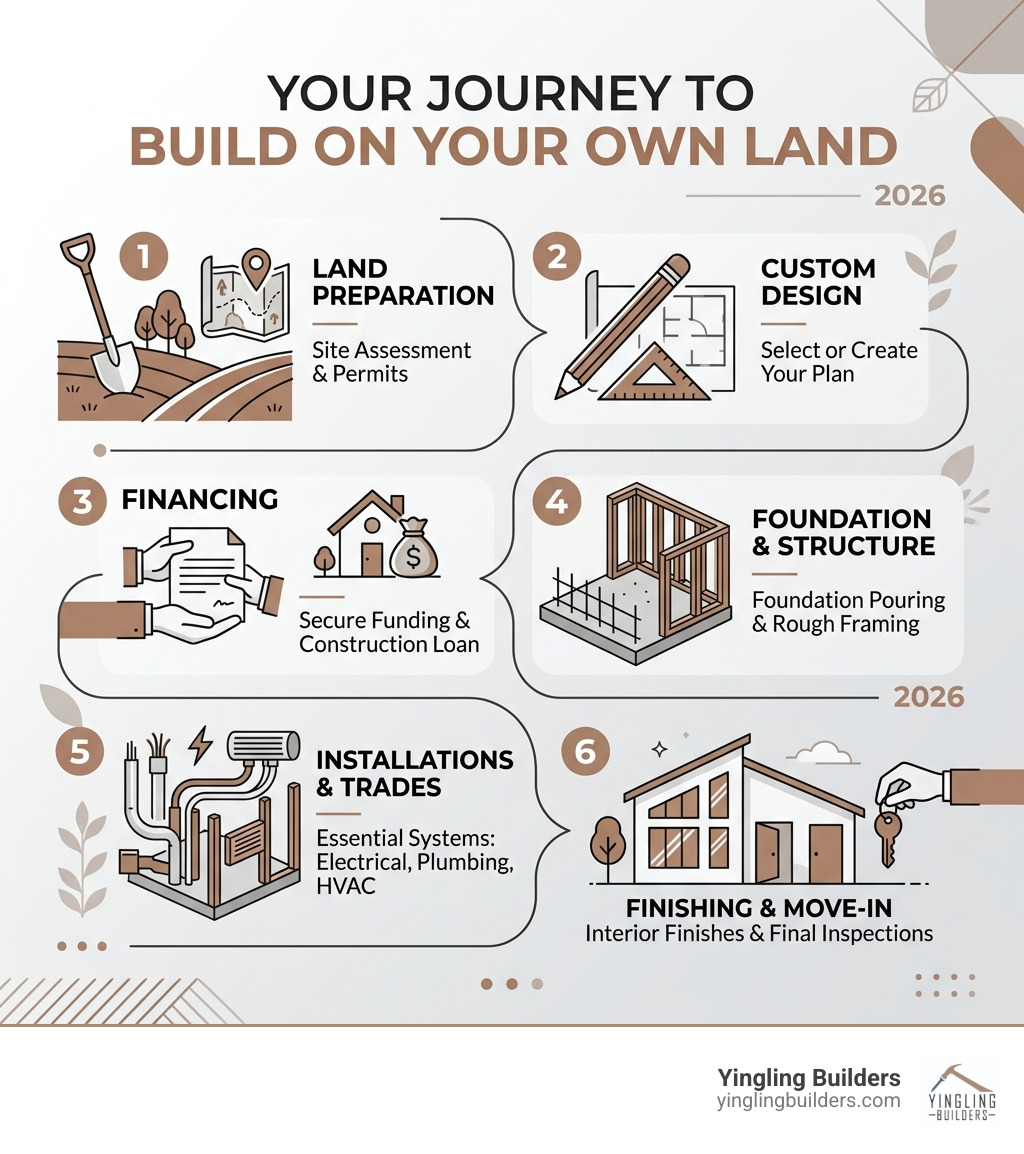
Here’s a quick overview of how the process works:
- Assess your land — confirm it’s buildable (soil, zoning, utilities)
- Secure financing — construction loan, FHA One-Time Close, or VA loan
- Design your home — floor plan, layout, and finishes tailored to your lot
- Pull permits — meet local county and municipality requirements
- Break ground — site prep, foundation, framing, mechanicals, finishes
- Move in — final inspection, certificate of occupancy, and keys in hand
On average, the full journey takes 6 to 12 months once construction begins — though land prep and permitting add time before that clock starts.
If you own a piece of land in West Central Illinois — or you’re looking to buy one — you may already be closer to your dream home than you think. The path isn’t without complexity, but with the right team and a clear roadmap, it’s one of the most rewarding investments you can make.
This guide walks you through every stage of the process: from evaluating your land and navigating permits, to financing, design, and the final walkthrough. Whether you’re rebuilding after a life change or starting fresh on a property you’ve owned for years, here’s everything you need to know.
Understanding the Build on Own Land Process
Building on your own land means constructing a custom residence on property you already own or are purchasing independently. This path offers unparalleled freedom in location and privacy. When we talk about Houses Built on Your Land, we are referring to a process that prioritizes your vision over a developer’s cookie-cutter template.
Whether you have a sprawling acreage in Brown County or a quiet wooded lot in Pike County, you aren’t restricted by the narrow boundaries of a modern housing development. You have the autonomy to decide exactly where the front door faces and how the sun hits your morning coffee nook.
Furthermore, this approach ensures an enhanced lifestyle and enduring quality. By choosing to build on own land, you are investing in a structure designed to last for generations. There is a distinct sense of pride that comes from buying vs building: the pros of constructing your dream home, as you gain complete property autonomy and a home that harmonizes with the natural Illinois landscape.
Essential Steps to Prepare Your Land for Construction
Preparing land to build on your own lot requires verifying soil stability, utility access, and local zoning compliance to ensure the site is legally and physically viable for a custom home. The preparation phase is critical to ensure the property is “buildable” and involves verifying that the physical characteristics of the lot can support your vision. It is much more than just clearing trees; it’s about constructing your own house in Illinois on a foundation that is safe and sustainable.
Preparation involves technical evaluations and securing legal permissions from local municipalities. In West Central Illinois, this means coordinating with officials in places like Mount Sterling, Quincy, or Pittsfield to ensure every box is checked before the first shovel hits the dirt. For those in rural areas, understanding Illinois private sewage disposal codes is a vital part of the planning process.
Assessing Land Suitability to Build on Own Land
Before breaking ground, you must evaluate the soil’s load-bearing capacity and drainage, as well as the availability of essential services like water, electricity, and sewage. Soil quality is a major factor; a soil test (often called a “perc test” for septic systems) confirms the land can support both a heavy foundation and necessary waste management.
In many rural areas we serve, such as near Griggsville or Winchester, municipal sewage isn’t always an option. This requires planning for private wells and septic systems. Additionally, we look at the grade slope. If your land has a significant incline, it may require specific engineering or retaining walls to prevent drainage issues. Clearing requirements—removing vegetation, debris, or old structures—must also be factored into your early timeline. Working with trusted home builders ensures these details are handled with professional oversight.
Navigating Local Restrictions and Permits
Every project must comply with specific county and city regulations, including setbacks, easements, and height restrictions. For example, the Planning & Zoning – City of Beardstown has specific codes that must be followed. These rules dictate how close to the property line you can build and ensure your home doesn’t interfere with local utility easements or environmental standards.
Securing building permits is a multi-step process that involves submitting architectural plans for review. You may also encounter deed restrictions or HOA rules if your land is part of a private tract. Navigating these zoning laws and environmental regulations is a standard part of our process to ensure you receive your certificate of occupancy without delay.
Planning Your Custom Home Investment
Financing a custom build on your own land typically involves a construction-to-permanent loan where funds are disbursed in stages, often allowing land equity to serve as a down payment. Financing a build-on-your-lot project typically requires a construction loan, which functions differently than a traditional mortgage. Instead of receiving a lump sum, the lender releases funds in “draws” as construction milestones (like the foundation or framing) are completed and inspected.
Many homeowners leverage the equity in their land to satisfy down payment requirements. If you own your land outright, that value can often count toward your equity stake, potentially reducing the cash you need upfront. For more information on state-specific lending oversight, you can visit the Illinois Department of Financial and Professional Regulation.
| Loan Type | Typical Down Payment | Key Feature |
|---|---|---|
| Construction-to-Permanent | 15-20% | Converts to a standard mortgage after move-in. |
| FHA One-Time Close | 3-4% | Single closing; requires a 620 minimum credit score. |
| VA Construction Loan | 0% (for eligible veterans) | No down payment; capped up to $1.5M by most lenders. |
Beyond the base price of the home, you must budget for site preparation, permits, and utility hookups. A thoughtful planning buffer helps protect the project from delays related to site conditions, weather, or material availability. For more details on budgeting, see our guide on custom home builders near me with prices.
The Step-by-Step Journey to Build on Own Land
The construction process follows a structured sequence from initial design through the final walkthrough, managed by a dedicated team to ensure precision. By following a proven roadmap, we ensure a seamless transition from a vacant lot to a finished, high-end custom residence. You can learn about our custom home process to see how we manage these moving parts.
The physical build begins with site clearing and grading to ensure a level surface. Next comes the foundation pouring, followed by the “skeleton” of the home: framing. Once the house is dried-in (roof and windows installed), we move to mechanical rough-ins, where plumbing, electrical, and HVAC systems are integrated. This journey from foundation to finish requires constant coordination to stay on schedule.
Designing with Expert Designers and Authentic Renderings
Collaborating with a team of expert designers allows you to customize floor plans that maximize the views and orientation of your specific lot. If your land overlooks a beautiful valley in Schuyler County, your home should be designed with expansive windows to capture that view.
For those seeking a detailed preview of their future home, authentic renderings are available as an optional service. These renderings help you visualize the final aesthetic, from siding colors to porch layouts, before construction begins. By working with our trusted partners, we ensure a lifestyle-driven design that feels personal. You can view our portfolio to see how these designs translate into real-world beauty.
Construction Execution with Experienced Oversight
Once permits are secured, the physical build begins, typically taking between 6 to 12 months depending on complexity and weather. We oversee every detail to ensure the structural integrity of the frame and the elegance of the final interior finishes meet our standards.
Yingling Builders emphasizes quality materials, disciplined project management, and craftsmanship built for long-term performance. From the initial site clearing to the final punch list, our focus is on craftsmanship that provides long-term value. As local home builders, we are personally invested in the quality of every home we build in our community.
Frequently Asked Questions about Building on Your Own Lot
How long does it typically take to build on my own land?
On average, the process takes 6 to 12 months once construction begins. However, the pre-construction phase—which includes land evaluation, soil testing, and permit approval times in Illinois—can add several months to the total timeline. Weather and design complexity are the two biggest variables that influence your final move-in date.
Can I use the land I already own as a down payment?
Yes! This is one of the biggest advantages of owning land. Most lenders allow you to use the appraised value or equity of your land toward the down payment for a construction loan. For instance, if you are using an FHA One-Time Close loan, your land equity can often cover the entire 3.5% minimum down payment requirement, meaning you may get a more streamlined path into the construction phase.
What are the most common mistakes to avoid?
The most common pitfall is failing to conduct a soil test or “perc” test before purchasing land or finalizing a design. If the soil cannot support a foundation or a septic system, the project can become significantly more complex. Another mistake is underestimating site preparation costs, such as clearing heavy timber or trenching long distances for utilities. Finally, always maintain a 10-15% contingency fund. Unexpected site conditions are a reality of custom building, and having a financial cushion ensures the project never stalls.
Conclusion
Choosing to build on your own land is one of the strongest ways to create a home that reflects your standards, lifestyle, and long-term vision. It is a journey that transforms a simple piece of Illinois earth into a sanctuary tailored specifically to your lifestyle. While the process involves many technical and financial steps, the reward is a high-value asset that offers privacy and autonomy you simply cannot find in a standard subdivision.
Yingling Builders specializes in this complex process throughout West Central Illinois—from Jacksonville to Quincy and everywhere in between. We pride ourselves on a client-focused partnership, a seamless construction process, and the dedicated craftsmanship required for high-end custom homes and renovations.
Ready to build a custom home on your land with a craftsmanship-first partner? Contact Yingling Builders to bring your vision to life with clarity, quality, and care.