
Why Hiring the Right Residential Remodelers Changes Everything
Residential remodelers plan and manage substantial home improvements, making contractor selection a critical first step in a successful renovation.
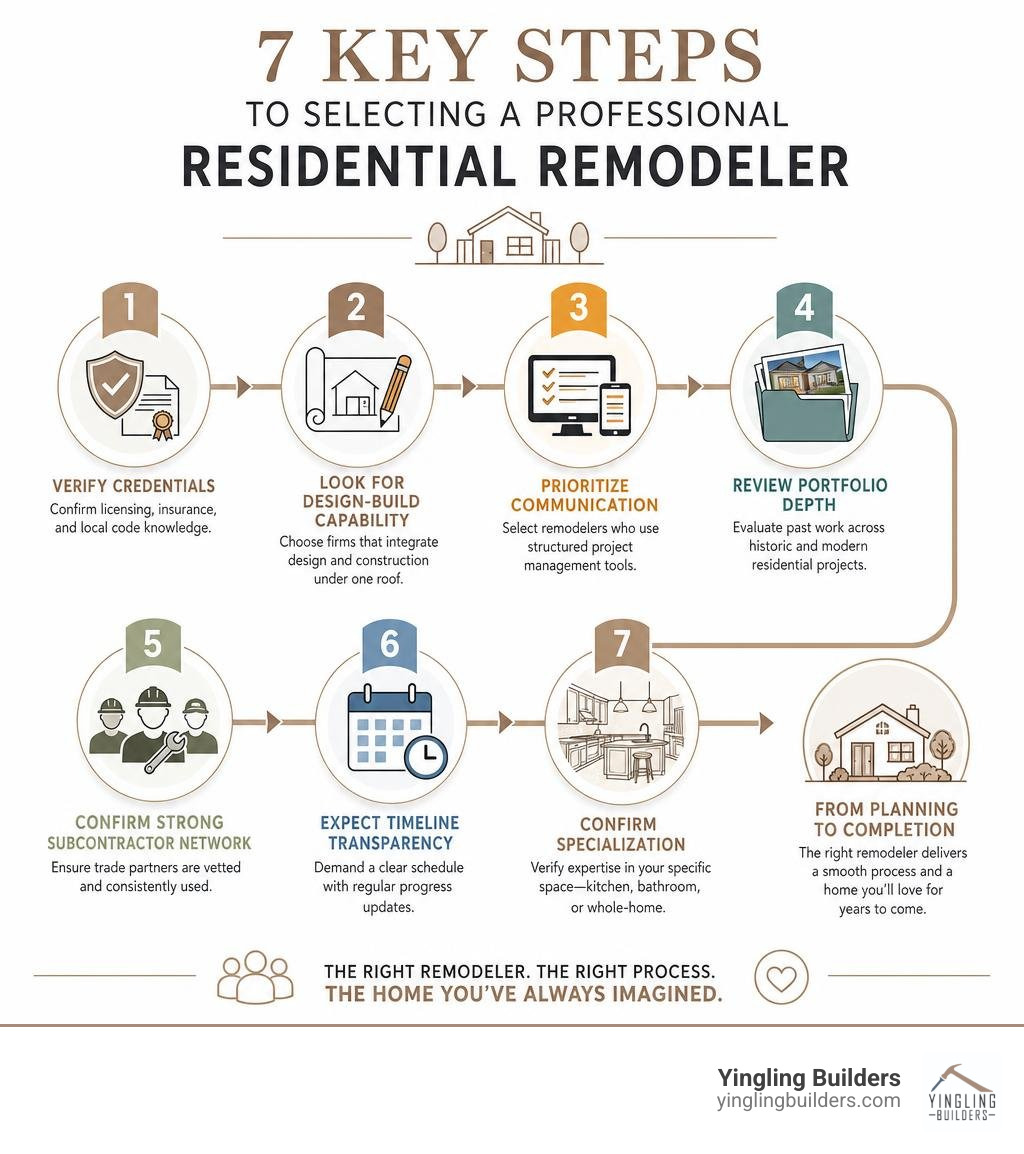
When comparing residential remodelers, evaluate these seven qualifications first:
- Credentials — Verify licensing, insurance, and local Illinois building code knowledge
- Design-build capability — Look for firms that integrate design and construction under one roof
- Communication tools — Prioritize remodelers who use structured project management platforms
- Portfolio depth — Review past work across both historic and modern residential projects
- Subcontractor network — Confirm that trade partners are vetted and consistently used
- Timeline transparency — Expect a clear project schedule with regular progress updates
- Specialization — Confirm expertise in the specific space you’re renovating, whether kitchen, bathroom, or whole-home
The number of residential remodeling businesses has increased substantially over the past two decades. An analysis of the 2022 Economic Census counted 128,187 establishments classified as residential remodelers, representing a 73% increase from 2007. That growth gives homeowners more choices, but qualifications, experience, and project-management standards can vary significantly among providers.
For homeowners in West Central Illinois, that reality makes due diligence even more important. Professional residential remodelers contribute more than construction labor; they coordinate design decisions, permitting, trade partners, scheduling, and quality control. When that process works well, the results are transformative. When it doesn’t, the consequences can be difficult and stressful to unwind.
National Association of Realtors research indicates that homeowners commonly value improved functionality, durable results, and enhanced aesthetics after remodeling. Experienced residential remodelers can reduce avoidable complications through detailed planning, documented schedules, and coordinated trade management. The stakes are high enough that knowing exactly what to look for — before you sign anything — is worth the effort.
This guide walks you through the key steps to finding a residential remodeler you can genuinely trust, with practical criteria that go well beyond reading a few online reviews.
1. Understand the Role of Professional Residential Remodelers
When you begin planning major updates to your home, it is essential to understand who you need for the job. Many homeowners mistakenly believe that a general contractor and a residential remodeler are entirely interchangeable. While both manage construction projects, specialized residential remodelers possess a deep and focused understanding of how to work within existing structural footprints, preserve architectural integrity, and execute complex luxury home renovations without disrupting your family’s daily life.
Home remodeling specialists coordinate the planning and construction requirements associated with additions, structural changes, interior renovations, and exterior improvements. They coordinate qualified specialty trades—including plumbers, finish carpenters, and electricians—to support consistent workmanship across the project. By focusing exclusively on residential properties, these experts master the nuances of structural modifications, wall removals, and layout reconfigurations.
A design-build model allows residential remodelers to coordinate design development and construction planning through one accountable team. In a traditional arrangement, the homeowner contracts separately with a designer or architect and later selects a contractor to construct the completed plans. Separate contracts can create coordination challenges when design decisions are not reviewed alongside construction requirements during planning.
By contrast, a design-build residential remodeler handles both the creative design phase and the physical construction under one unified contract. This single-source accountability helps keep design intent, material decisions, and construction requirements aligned throughout the project. Below is a comparison table to help you understand the differences between these two approaches:
| Feature | Design-Build Residential Remodeler | Traditional General Contractor |
|---|---|---|
| Point of Contact | Single, unified team from design to completion | Multiple (Architect, Designer, Contractor) |
| Design Integration | Expert designers and trusted partners | Client must provide pre-drawn architectural plans |
| Communication | Highly streamlined via project management software | Often fragmented across separate businesses |
| Accountability | Full responsibility for both design accuracy and build quality | Builder may blame architect for design flaws and vice versa |
| Design Optimization | Continuous optimization of materials and structural planning | Harder to adjust plans once construction begins |
2. Verify Credentials and Local Illinois Licensing
Next, verify that prospective residential remodelers carry appropriate insurance, provide applicable credentials, and understand the permit and registration requirements for your project location. In Illinois, licensing and registration requirements can vary significantly by municipality, making it essential to partner with a team that is deeply familiar with the local regulatory landscape. A professional firm will proudly share their credentials, liability insurance coverage, and workers’ compensation documentation up front.
When evaluating a home remodeling company, you must ensure they adhere strictly to the guidelines established by the Illinois Capital Development Board Building Codes. These requirements address structural performance, fire safety, energy efficiency, and occupant protection. A remodeler with a strong local presence will have established relationships with building departments throughout West Central Illinois, from Quincy to Jacksonville.
Working with local specialists who understand municipal nuances is incredibly valuable. Residential remodelers with experience in communities such as Griggsville, Beardstown, Winchester, and White Hall are more likely to understand local permitting contacts and municipal procedures. This localized expertise ensures that your project complies with municipal zoning laws and specific neighborhood restrictions.
Furthermore, a certified residential remodeler will have a proven track record of passing municipal inspections. Whether your home is located in Winchester or White Hall, your contractor must understand local soil conditions, regional climate challenges, and municipal codes. Homeowners should confirm applicable registrations directly with the municipality or county responsible for the project location.
3. Evaluate the Design-Build Process and Communication Tools
A successful remodel is built on a foundation of clear, transparent communication. Organized residential remodelers use documented communication systems to share schedules, selections, approvals, and project updates. When you partner with us, Yingling Builders uses Buildertrend to provide project updates, schedule visibility, and a centralized location for selection decisions.

During the initial planning stages, we coordinate with designers and trusted partners to create detailed visual renderings of proposed spaces. These optional, highly detailed visual tools allow you to see exactly how your renovated kitchen, bathroom, or whole-home layout will look before a single hammer is swung. This collaborative design phase ensures that we align every detail with your aesthetic preferences and functional requirements.
Our structured construction process is designed to reduce uncertainty through documented planning, communication, and project coordination. Coordinating design, material procurement, and construction through one team can reduce handoff problems and support smoother project transitions. This level of organization is particularly important when managing complex plumbing, electrical, and structural modifications that must meet safety and environmental standards.
To ensure your home remains safe and healthy throughout the renovation, professional residential remodelers must also adhere to strict environmental guidelines. For covered pre-1978 homes, residential remodelers should follow applicable EPA certification, containment, cleaning, and lead-safe work-practice requirements. Our commitment to maintaining clean, organized, and safe job sites protects both our skilled craftspeople and your family.
4. Review Portfolios for Historic and Modern Expertise
West Central Illinois is home to an incredible variety of architectural styles, from historic 19th-century brick homes to sleek, contemporary modern residences. When searching for residential remodelers, it is vital to review their portfolio to confirm they have hands-on experience with the specific style of your home. A portfolio is a testament to a builder’s craftsmanship, attention to detail, and versatility.
If you own an older property in Pittsfield or Jacksonville, you need a contractor who specializes in historic home renovation. Restoring a historic home requires a delicate balance of preserving original character—such as plaster walls, hand-carved millwork, and vintage masonry—while seamlessly integrating modern plumbing, electrical systems, and energy-efficient insulation. Our team respects the historical fabric of these structures while upgrading them for modern living.
Historic projects should be informed by preservation guidance that supports compatible repairs, appropriate materials, and protection of original architectural features. Review completed historic projects closely for evidence of compatible millwork, masonry repair, finish matching, and careful integration of modern systems. Our localized craftsmanship ensures that every historic home renovation in Pittsfield or Jacksonville is executed with the utmost care and precision.
Conversely, if your home features a mid-century or contemporary design, your residential remodelers must understand modern construction techniques. This includes creating clean, minimalist trim lines, installing large-format tile, and integrating smart home technology. By choosing an experienced Illinois home builder with a diverse portfolio, you can rest assured that your home’s unique architectural style will be celebrated and enhanced.
5. Assess Project Timelines and Planning Standards
One of the most common concerns homeowners have when embarking on a major renovation is the project timeline. Experienced residential remodelers understand that thorough pre-construction planning is the key to maintaining a predictable schedule. We dedicate significant time to the planning phase—ordering materials, securing permits, and scheduling trades—before any physical work begins on your property.

The schedule for a major renovation depends on design complexity, permitting, structural work, material availability, and the number of specialty trades involved. This duration allows our in-house team of skilled craftspeople to execute every detail to our uncompromising standards. A reliable schedule should allow sufficient time for structural coordination, required inspections, material installation, and detailed finish work.
To help you navigate this process, we recommend reviewing our ultimate custom home renovation guide, which outlines what to expect during each phase of your project. From the initial conceptual drawings to the final punch list, having a clear understanding of the workflow helps reduce anxiety and allows you to plan your life accordingly during construction.
Additionally, our planning process places a heavy emphasis on energy efficiency and modern building science. Applicable insulation, HVAC, and window work should be planned in accordance with the current Illinois Energy Conservation Code and local enforcement requirements. By incorporating these advanced standards, your renovated home will not only look beautiful but will also perform exceptionally well, providing year-round comfort and long-term utility performance.
6. Look for Specialized Expertise in High-End Spaces
A whole-home renovation is a collection of specialized spaces, each requiring a unique set of skills. When interviewing residential remodelers, ask about their specific experience in designing and executing high-end kitchens and luxury bathrooms. These spaces are highly technical, involving intricate plumbing configurations, complex electrical layouts, and premium finishes that require master-level installation.
Kitchen Transformations by Expert Residential Remodelers
The kitchen is the heart of the home, and modern families require layouts that support both daily living and elegant entertaining. Professional remodelers excel at layout optimization, which often involves removing load-bearing walls to create open-concept kitchen and living spaces. This structural work must be engineered precisely to ensure the safety and stability of your home.
Experienced residential remodelers coordinate cabinetry, appliance specifications, countertop selections, lighting, and structural requirements as one integrated kitchen plan. For a deeper look into our approach, explore the complete guide to kitchen remodeling. Working with seasoned professionals who understand the high standards expected in luxury West Central Illinois homes ensures that your culinary space is both beautiful and highly functional.
Spa-Like Bathrooms Crafted by Residential Remodelers
A luxury bathroom should serve as a private sanctuary, blending sophisticated design with ultimate functionality. Achieving this requires meticulous attention to detail behind the walls. Proper waterproofing systems, advanced ventilation, and precise tile alignment are critical to preventing moisture damage and ensuring your beautiful new space stands the test of time.
Our team plans custom vanities, layered lighting, curbless showers, freestanding tubs, ventilation, and waterproofing as a coordinated bathroom system. By reviewing our guide on kitchen and bathroom renovations, you can learn more about how we blend timeless aesthetics with modern plumbing technology to create spaces that are as functional as they are beautiful.
7. Tour Active Developments and Completed Projects
Before selecting a contractor, ask whether you can tour a completed project or view detailed examples of comparable work. Seeing a contractor’s work in person allows you to evaluate their cleanliness, organization, and the physical quality of their craftsmanship. A clean, orderly job site is a strong indicator of a professional, respectful team that treats your home as if it were their own.
Touring projects completed by residential remodelers helps you evaluate finish quality, architectural integration, and consistency across different project types. This is particularly important in master-planned communities where cohesive design and architectural harmony are highly valued. For example, our work in the Neylon Farms community showcases our commitment to building beautiful, generation-lasting homes that perfectly complement their surroundings.
Working with custom home remodelers creates a long-term project relationship that depends on communication, accountability, and mutual trust. Speaking with past clients during a home tour can provide invaluable insights into a builder’s communication style, problem-solving abilities, and overall reliability. We take immense pride in the relationships we build with our clients, and we are always happy to connect you with homeowners who have experienced our process firsthand.
Frequently Asked Questions About Residential Remodeling
What is the typical timeline for a luxury home renovation?
A comprehensive renovation schedule varies according to scope, structural complexity, approvals, selections, and trade coordination. This timeline includes a meticulous planning phase, structural engineering, material procurement, and the physical construction executed by our skilled in-house team. Taking the necessary time ensures that every detail meets our strict quality standards.
How do professional remodelers handle design and permitting?
Professional residential remodelers utilize a design-build approach, meaning we coordinate with a team of expert designers and trusted partners to handle all architectural drawings and authentic renderings. Once the design is finalized, we manage the entire permitting process with your local municipal building department, ensuring full compliance with all local codes and zoning restrictions.
How does the design-build approach differ from a traditional construction arrangement?
The design-build approach provides single-source accountability, meaning one team is responsible for both the design and construction of your project. This eliminates communication gaps between separate architects and builders, streamlines the schedule, and allows for continuous design optimization. We utilize BuilderTrend to keep you connected and informed throughout the entire process.
Conclusion
Choosing qualified residential remodelers is a foundational step in planning a successful home renovation. By prioritizing clear credentials, a robust design-build process, modern communication tools, and a deep respect for local building standards, you can ensure a stress-free and rewarding renovation experience.
As a premier Illinois home builder, Yingling Builders is dedicated to delivering beautiful, highly functional spaces with minimal disruption to your life. Whether you are planning a historic restoration, a modern kitchen transformation, or a complete whole-home renovation, our team has the expertise and local knowledge to bring your vision to life.
Planning a whole-home renovation, historic restoration, kitchen update, or bathroom remodel in West Central Illinois? Contact Yingling Builders to discuss your goals, project scope, and next steps with experienced residential remodelers.
0 Comments